
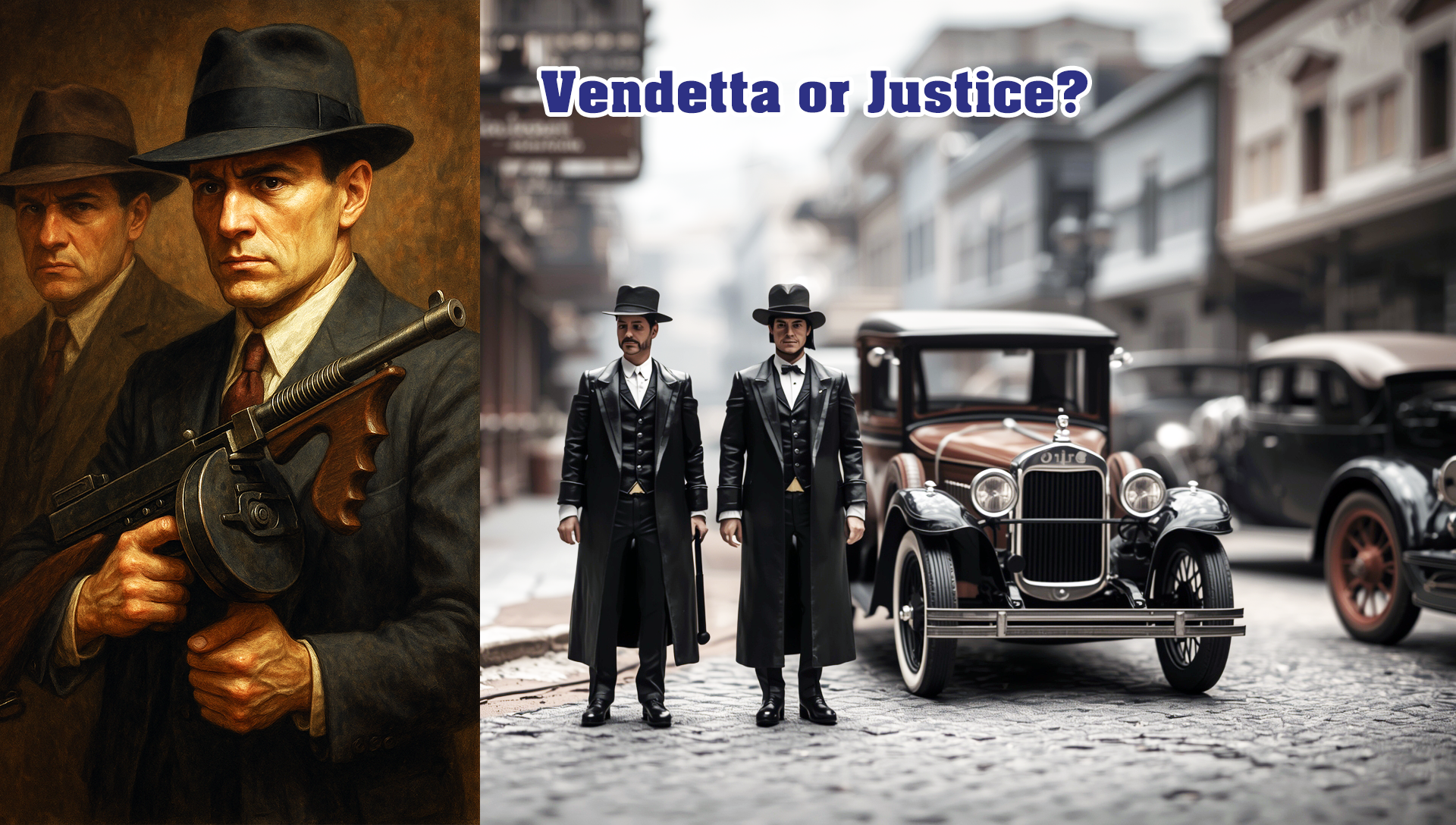
The Word Vendetta: History, Meaning, and Cultural Resonances
The word “vendetta” immediately evokes an image charged with tension, violence, and drama. It is a term that, beyond its linguistic definition, has become a universal symbol of hatred, personal justice, and the perpetuation of conflict. Its expressive power has led to its use not only in historical and social contexts, but also in literature, film, music, and even contemporary political language. Understanding the history of this word involves delving into the roots of Mediterranean societies, into the traditions of honor and revenge, and into the cultural mechanisms that have kept its echoes alive to this day.
Etymology and Origin

Vendetta comes from Italian and literally means “revenge.” The term is derived from the Latin verb vindicare, which means to claim, punish, or avenge. Vindicare also gives rise to other words such as “vindicate” or “vindication,” which are related to the defense of a right or the correction of an injustice. However, while in Spanish and other Romance languages the notion was nuanced in the legal or moral realm, in Italian it evolved toward a much more visceral connotation: revenge as a personal act and a duty of blood.
From its origins, vendetta is not simply an isolated reprisal, but a socially structured practice. In Italy, especially in regions such as Sicily, Calabria, and Sardinia, the term came to designate a collective phenomenon: the prolonged enmity between families or clans that was passed down from generation to generation.
Vendetta as a social institution

In societies where the state was weak or nonexistent, justice was vested in the community. Vendetta then functioned as an alternative system for conflict resolution. If someone murdered, humiliated, or deprived a member of a family, the relatives had an obligation to respond, not only to repair the damage, but also to maintain their honor and social position.
This mechanism, although brutal, possessed an internal logic. In the absence of effective courts, the threat of revenge served as a deterrent to abuse. However, the cost was high: endless spirals of violence ensued, with each act of retaliation leading to another, cementing enmities that could last for decades. Examples of these family feuds abound in the history of southern Italy and also in other Mediterranean and Balkan cultures, demonstrating that vendetta was not simply a local custom, but a human pattern repeated in different contexts.
Vendetta in Literature and Art
The imagery of vendetta became a powerful literary device. In classical tragedies, medieval epics, and Renaissance plays, revenge appears as a fundamental narrative driving force. Shakespeare, for example, constructed Hamlet around the moral dilemma of avenging one’s father’s death. Although he doesn’t use the Italian word, the idea is essentially the same.
In Italian literature, authors such as Giovanni Verga portrayed the weight of vendetta in rural communities, showing how it trapped families in an inevitable fate. In the 19th and 20th centuries, the term spread internationally, associated with organized crime and the Sicilian mafia, reinforced by novels and later by cinema.

In modern popular culture, vendetta became a symbol of rebellion against oppression. The comic book and film V for Vendetta (2005) redefined the concept: from an act of private revenge to a political metaphor for the struggle against authoritarian governments. In this context, the word took on an almost heroic tone, linked to social justice and not just personal revenge.
Psychological and Cultural Resonances
The interesting thing about the word vendetta is that it doesn’t just describe an action; it conveys an emotional atmosphere. It speaks of anger, resentment, but also a sense of duty. Unlike “revenge” in the abstract, vendetta has connotations of ritual, historical continuity, and belonging to a collective. It is not about an individual taking revenge, but about a family, a clan, or even an entire people feeling the need to balance the scales.
In this sense, the word is associated with a universal dilemma: to what extent is it legitimate to take justice into one’s own hands? Is vendetta a way of defending one’s honor when institutions fail, or simply a destructive cycle that impedes social progress? These questions, beyond the historical, remain relevant in contemporary debates about violence, community justice, and reconciliation.
Vendetta in political and media language
Today, the word is frequently used in the media and in politics, albeit in a more metaphorical sense. Political vendetta is spoken of when a leader or party retaliates against their adversaries, using institutions to settle personal scores. In this context, the term retains its emotional force but loses the literal bloodshed of its origins.
Thus, headlines like “judicial vendetta,” “corporate vendetta,” or “media vendetta” seek to convey the idea of a settling of scores disguised as legality or strategy. In this way, the word has transcended its original cultural context and has become globalized as a synonym for personally motivated retaliation.
Conclusion
The word vendetta is much more than an Italianism adopted in multiple languages. It represents a complex concept that blends justice, hatred, duty, and collective memory. Its strength lies in the fact that it does not name a single action, but rather a chain of events that perpetuate themselves over time.
From Sicilian clans to the Hollywood big screen, passing through contemporary political rhetoric, vendetta has remained alive as one of those words laden with universal symbolism. To study it is to understand not only a custom of revenge, but a way in which human beings have attempted—with greater or lesser success—to deal with violence, honor, and justice.