
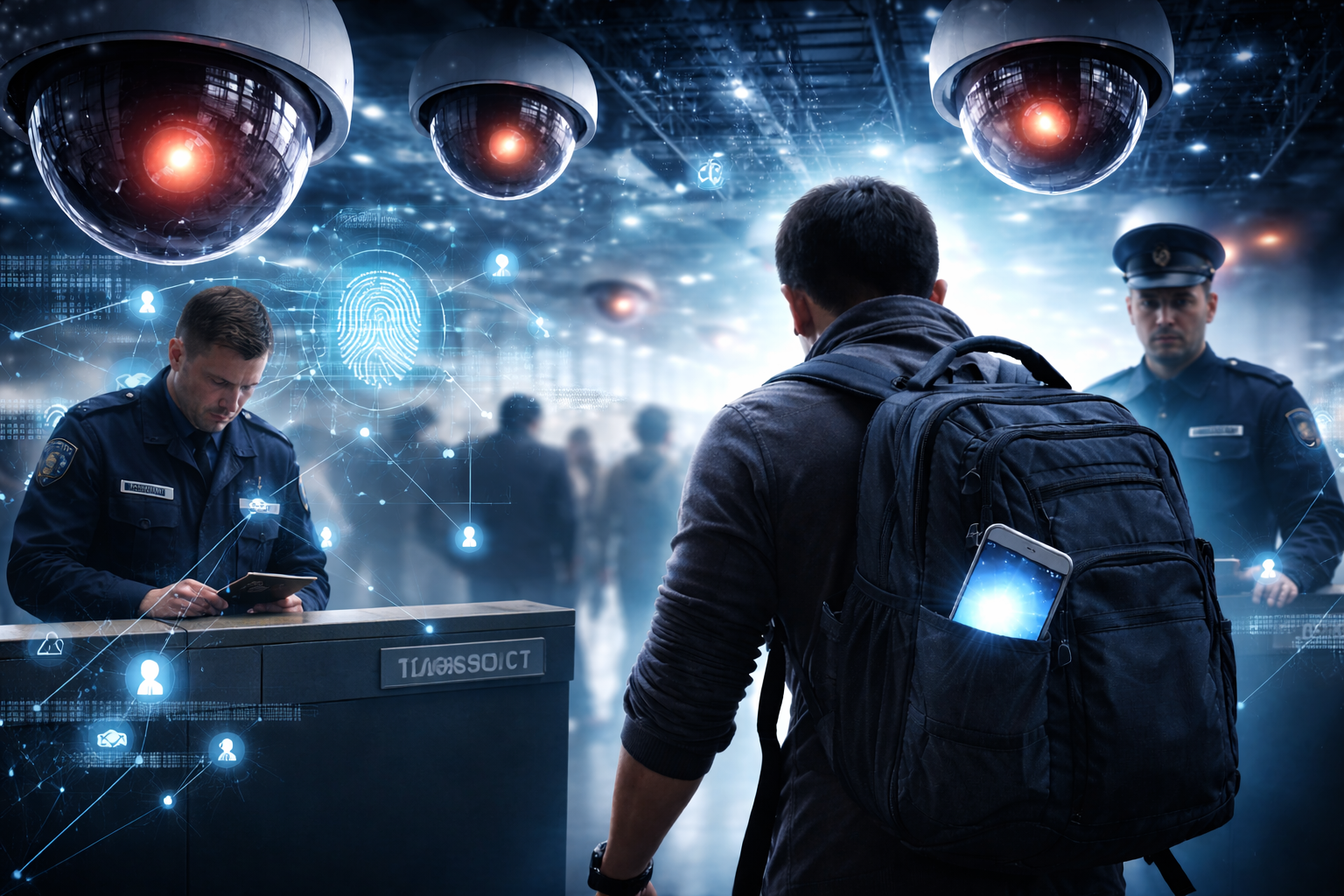
Airports, Surveillance, and the Phone Search Myth
What the Government Actually Sees When You Cross a Border
For years, a powerful but misleading idea has taken hold: that when you pass through an international airport, the government can instantly access everything on your phone. Messages. Photos. Contacts. Social media posts from five or ten years ago. All open. All read. All stored.
It is a frightening image.
It is also largely wrong.
This does not mean airports are neutral spaces, or that surveillance does not exist. It means something less dramatic and more realistic: control exists, but it is limited, selective, and shaped by human decisions. And like any human system, it prioritizes, misses things, and lets many people through.
The airport is a checkpoint, not a digital crystal ball
An airport is, first and foremost, a logistics and security checkpoint. Millions of travelers cross borders every week. The system is designed to sort risk, not to scan the full digital history of every passenger.
In practice, authorities can:
Verify documents and biometrics
Record travel movements and prior entries
Detect devices and network connections
Analyze network metadata on controlled systems
What they cannot do—automatically and at scale—is read encrypted content stored on personal phones.
Not today. Not routinely. Not across millions of travelers.
Modern encryption is real, not theoretical. And it works even against governments with vast resources.
Real-world cases that challenge the idea of total control
If airports were capable of seeing into a traveler’s full digital past, many recent cases would be hard to explain.

Snowden was not flagged by an airport system
Edward Snowden traveled through international airports for years without being stopped by automated screening systems. He was not identified by a scanner or an algorithm at customs. He became a target only after classified information was made public and political decisions followed.
The system did not “see his past” at the border.
It responded later.
Oligarchs and financiers moved freely—until politics changed
For decades, Russian businessmen now under sanctions—including Roman Abramovich—entered Western countries without issue. Not because they were hidden, but because they were not considered priorities at the time.
Their phones were not searched. Their digital histories were not reconstructed at airports.
The scrutiny began only when geopolitical conditions changed.
Financial criminals who crossed borders without trouble
Many individuals later charged with international financial crimes have acknowledged traveling freely for years. They did not defeat an all-seeing system. They simply were not on any active watch-list.
This was not a failure of surveillance.
It was how the system operates.
How authorities decide who gets extra scrutiny
Border surveillance is not equal or universal. It is selective by design.
Deeper inspections are usually triggered by:
Existing legal or court alerts
Matches on specific watch-lists
Prior intelligence reporting
Particular political or security contexts
Phones become relevant only after those factors are present, and only when legal authority and operational capacity exist. They are not the starting point.
The most common myth: “They can see everything on your phone”
The most repeated claim—and the most misunderstood—is that border authorities can see everything stored on a phone.
The reality is far more limited.
They can:
Detect the presence of a device
Collect connection metadata
Link identity, travel records, and a device
They generally cannot, at scale:
Read encrypted messages
Access private photos
Pull full social media histories
Reconstruct years of activity directly from a phone
When governments analyze past posts, contacts, or statements, they do not do it at the airport. They rely on external sources: digital platforms, legal records, or publicly available information.
The airport confirms identity.
It does not recreate personal history.
The debate we keep missing
The real issue is not that the government “sees everything.”
It does not.
The real issue is when authorities choose to look, who they choose to examine, and under what rules and oversight.
The myth of total surveillance dulls public debate. If everything is already watched, there is nothing left to question. But once the limits of the system are understood, the conversation changes.
The key questions are no longer “Can they do it?” but:
Under what conditions?
With what safeguards?
And who oversees the process?
Less fear, more clarity
Airports are not power-free zones. But they are not automatic digital courts either. Modern surveillance is expensive, imperfect, and dependent on human judgment.
Believing every phone is an open book does not make travelers safer.
It shifts attention away from the real issue: how power is used, and where its boundaries should be.
And while myths dominate the conversation, the serious debate about those boundaries remains out of focus.